
Your property address contains valuable information that can influence the cost of a concrete project, including local pricing conditions, soil characteristics, permitting requirements, zoning considerations, and other site-specific factors. The challenge is that this information is often spread across multiple data sources, making it difficult for contractors—to gather and evaluate efficiently. This is in part why most concrete contractors lack the ability to offer instant estimates.
To simplify the process, we built an address-based estimating tool that combines aerial measurements with location-specific pricing data. After entering your property address, you can trace the concrete project area directly from a satellite map, specify project details, and receive an estimate in just a few minutes based on local market conditions in the US.
The calculator is designed for:
- Exterior residential concrete project estimates
- Foundation slabs, patios, sidewalks, driveways, and RV pads
- Estimates based on project-specific variables rather than generic square-foot averages
If you are asking, “How do I estimate the cost of a concrete slab from my property address?” this guide walks you through it step by step.
1. Measure the slab area from the map
The size of the slab is a major cost driver. A larger slab needs more concrete, more base work, and more labor.
You can measure your site by hand with a tape, but for many homes, it is faster to use an aerial map. Once you pull up the concrete calculator, you’ll be prompted for your address.
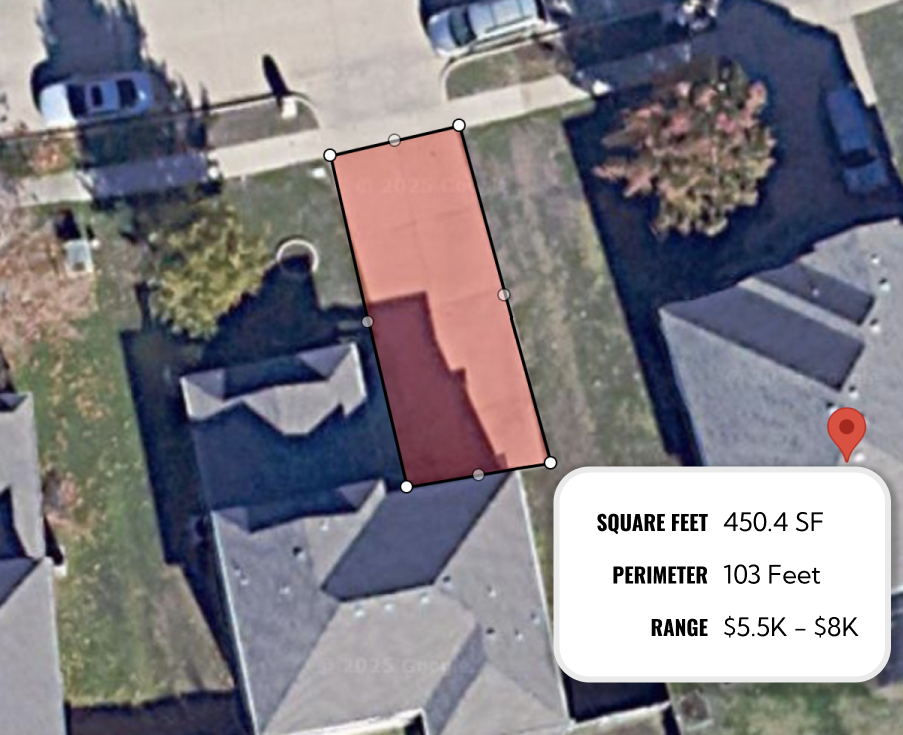
After you enter your address, you’ll see a picture of your property on the map. You’ll select either Sketch or Box mode based on the shape of your slab.
For slabs that are perfectly rectangular, you can use box mode. The majority of slabs, however, come in odd shapes and need “Sketch” mode.
Tap and click so the dots frame the entire proposed area. Ensure you enclose the polygon so the area is filled with a light red hue.
2. Add slab details to improve the accuracy of your concrete estimate
After sketching the area where the concrete should be poured, the next step is entering project details. This is where many rough estimates go wrong.
Not all slabs are the same. A 4-inch slab requires significantly less concrete than a 6-inch slab. Plus, concrete strength (e.g. PSI) can significantly alter the cost of raw inputs.
To make it easy, we’ve indicated popular thickness and PSI levels based on the type of project you are engaging in. For example, sidewalks tend to be around 3000 PSI whereas driveways typically start at 3500 PSI or higher.
3. Check local costs tied to your address
Your address does more than show the lot. It also helps connect your estimate to local conditions.
Concrete prices are not the same in every city. Labor, cement cost, delivery fees, and local pricing trends can all change what you pay.
Why location matters
- Concrete material prices vary by region
- Labor costs change from one market to another
- Travel and truck access can raise delivery cost
- Permit needs may differ by city or county
This is one reason many online pricing guides feel too broad. They may give a national average, but your real project cost depends on your location and job setup.
This is where the concrete calculator shines because it uses real construction variables and real-time pricing indices tied to the project location. That gives homeowners a more grounded way to estimate concrete slab cost by address instead of using a one-size-fits-all guess.
4. Compare your estimate before you call a contractor
Once you have the slab size, details, and local cost factors, you can review the estimate. This gives you a better base before you ask for bids.
This does not replace a site visit. You are trying to get a clear range so you can budget and ask better questions.
What to do with your estimate
- Check if the slab size looks right
- Review thickness and PSI choices
- Highlight any drainage or access issues that may significantly alter the price
- Provide your specs to contractors
A reliable concrete slab estimate helps homeowners avoid two common mistakes: underestimating project costs and comparing contractor bids that are based on different assumptions.
When contractors price a project, they may make different assumptions about slab thickness, reinforcement, site preparation, excavation, access conditions, or finishing requirements. As a result, two bids can vary significantly even when they appear to cover the same project. Establishing a consistent scope of work makes it easier to compare proposals and understand where pricing differences come from.
Site conditions are often one of the biggest drivers of cost. Limited access, difficult terrain, or poor soil conditions can increase labor requirements and equipment costs. For example, restricted access may require a contractor to use specialized equipment, additional crew members, or a concrete pump to place and finish the concrete efficiently before it begins to set.
Understanding these variables upfront can help you build a more realistic budget and evaluate contractor bids with greater confidence.
Final thoughts on how to estimate concrete slab cost by address
If you need to estimate concrete slab cost, start with your address, measure the slab area, add the right project details, and review local pricing factors using the Interactive Concrete Cost Calculator. That gives you a much better number than a broad national average.
For many homeowners, the easiest path is to use a map-based tool that lets you trace the slab and enter key specs. It is a simple way to plan for a house foundation slab estimate, concrete driveway cost estimate, or other exterior flatwork.